There's a low intensity, yet long running debate about quests and peril to people who aren't participating. The crux of the matter is there are some quests where the entire mud becomes a pretty dangerous place whether you are involved with the quest or not, so characters who are unaware of what is happening can be killed.
An example of this is the "blue steel gang" that went into towns and hunted players. As many of you may remember, players severely criticized it during the event, but afterward there was much praise about the quality and theme. Certainly there were players who are often away from the keyboard that were disgruntled even after its conclusion. In fact, there was significant debate among the admin during the quest as to whether or not this type of event should be allowed to be done again or even if that one should have continued. In the end, a well thought out theme that made the mud more dangerous was accepted as an improvement by the admin.
One of my beliefs is: The mud should be a dangerous place. Expecting to amble blissfully about or go away from the keyboard with no consequences is something people have gotten away long enough for it to be comfortable. That doesn't mean it should be this way. Few argue that exploring shouldn't be dangerous, but they argue walking around town should be safe. It is most of the time, but in my opinion, there's no halo around towns. Players sack towns constantly; why should mobs be excluded from hunting players there?
I'd like to see us make it more dangerous by putting in themes and long running (like several weeks or months) quests that can cause disruption to existing play. The quests, will of course, have rewards. These don't necessarily all have to be drachma, spells, skills, but will be worthwhile for those who participate. They may be simply for the larger good like something as simple as the mud is a safer place for the next few weeks. Long running quests that increase danger are disruptive and SlothMUD players like certainty and predictability. And while I believe we shouldn't provide either, we certainly don't want random, purposeless death, either. Any increase is sure to stir a controversy with players.
There are plenty of reasons to go away from the keyboard for extended periods of time. The only really safe way to do it is to rent out. This has a small cost associated with it and players often try to avoid this by not renting. That's a risk/reward which currently has nearly zero risk. If the mud is a more dangerous place the risk goes up and fewer people will take it, at the expense of paying a little more in rent. A few that do take the risk will be unlucky and face the consequences of trying to figure out what happened while they were away.
A counter argument states that we have the "join" command that allows people to participate or not. So why not just use that for all quests and themes that might attack players? I'm all in favor of this when the event has a declared reward is time boxed. However, in the case where the reward isn't obvious, or even that there is a clear objective, I'm not in favor of using this. Nobody would ever have the join flag on outside of the clearly announced events.
By no means is this a done deal. These are my own opinions and I haven't convinced the rest of the admin of this, so we aren't moving forward on it yet. We shall see if we can harness some creativity and muster the effort to implement a broader, more permanent theme that will indeed make the mud more dangerous.
Wednesday, December 13, 2006


Monday, December 04, 2006
Pure Java is Better Than Starbucks Coffee
I enjoy a cup of joe Starbucks like most people, but when it comes to coding Java, there ain't nothing like Intellij IDEA from JetBrains. Those people know Java and those people know IDE's. I've done a lot of coding on a lot of different platforms and I think that I come back to Java a lot when I don' t know what else to choose simply because of the quality of this piece of software.
Some of you hard core guys out there will never use an IDE because it takes too long to learn or for some other reason that escapes me now. It took me a long time to get over the hump, but now that I am, I won't go back. Features like refactoring, method extraction, integrated debugging and drag and drop GUI widget just can't be done with vi or notepad.
If you are just starting Java or some other language, by all means get out notepad and start making mistakes so you know what all of the different things in the language do, but if you know the language, try an IDE. I don't particularily like Eclipse for Java, by the way; It just doesn't have the coolness factor of IntelliJ IDEA.
Here's a screenshot of an standalone Java application that I'm working on as a tool for builders who will be working on an upcoming Sloth enhancement. Just a teaser for now, but I will have it fully functional soon.
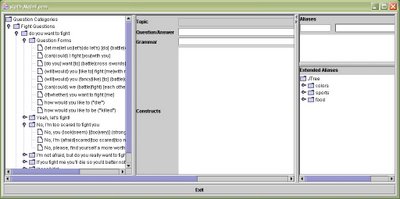
It is a Java Swing application that I developed with a lot of drag an drop, trial and error in the IDE to get it to behave exactly like I want. It would have taken me four or five times as long to do this without and IDE or else I would have stopped short with an inferior product.
Perhaps I'm just a poor coder whom uses the IDE as a crutch, but I don't think so.
If I get a little time soon, I may even describe in some more detail what this project is if Kjartan doesn't get around to it. In any case, it will be something unique to Sloth.
Some of you hard core guys out there will never use an IDE because it takes too long to learn or for some other reason that escapes me now. It took me a long time to get over the hump, but now that I am, I won't go back. Features like refactoring, method extraction, integrated debugging and drag and drop GUI widget just can't be done with vi or notepad.
If you are just starting Java or some other language, by all means get out notepad and start making mistakes so you know what all of the different things in the language do, but if you know the language, try an IDE. I don't particularily like Eclipse for Java, by the way; It just doesn't have the coolness factor of IntelliJ IDEA.
Here's a screenshot of an standalone Java application that I'm working on as a tool for builders who will be working on an upcoming Sloth enhancement. Just a teaser for now, but I will have it fully functional soon.
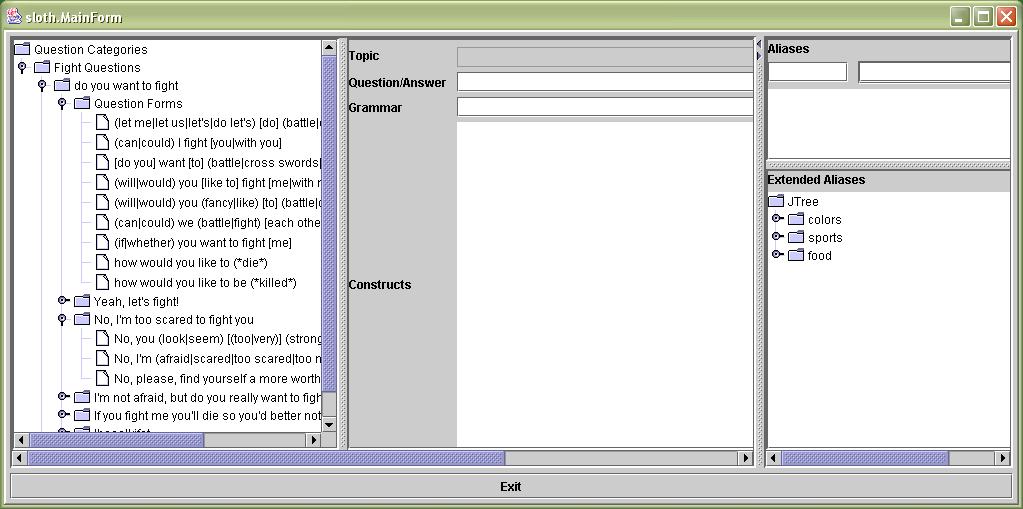
It is a Java Swing application that I developed with a lot of drag an drop, trial and error in the IDE to get it to behave exactly like I want. It would have taken me four or five times as long to do this without and IDE or else I would have stopped short with an inferior product.
Perhaps I'm just a poor coder whom uses the IDE as a crutch, but I don't think so.
If I get a little time soon, I may even describe in some more detail what this project is if Kjartan doesn't get around to it. In any case, it will be something unique to Sloth.
Sunday, November 05, 2006
Fauxnetics and Tipos
Playing a text based game is somewhat of an anomaly in today’s computer graphic intensive world. Interacting with them can be difficult at time, even when immersed in the game.
The English language is full complex spelling rules. “ph” sounds like ‘f”; “tion” sounds like “shun”; and my personal favorite the silent “e”. The Qwerty keyboard is designed to slow people down when typing which increases typos when people rush. The most commonly typed letters are moved off of he home row and the only vowel on the home row is on the left pinky; for most right handed people, their weakest finger. There are also colloquial spellings that complicate interaction. In the fantasy world, a Brit may attempt to cast a ‘colour spray’ or ‘color spray’ at his foe depending on where the thought the game creators are from.
For native English speakers it can be frustrating at times. Much of this has been made much easier by the standard and advanced features of MUD clients. But, there are still frequent situations where typing of unfamiliar things is required.
We focused some of our time at what players were typing to find help. We noticed that about 90% of all entries that didn’t return a result were misspellings. The other 10% were topics that were either not covered or just use a different reference. We corrected the latter relatively easily. The suggestion was made to correct the typos or misspellings by applying an algorithm based on phonetics.
We did a little investigation and testing and think that probably 90% of the typos will be corrected by this implementation. It’s particularly important to us because of the number of non-native English speakers we have.
As usual, this was a group effort. Kjartan came up with the suggestion, I did the coding and Splork did data gathering and testing. The coding was much harder for me than it should have been, though. I often switch languages depending on the project I working on. In this case, there isn’t much choice since the game is coded in mostly in C. For some reason I got quite confused on how C uses pass by value instead of pass by reference. Specifically, I wasted several hours of time debugging and rewriting the same 20 lines of code until I used examples in Wikipedia which reminded me I needed to use pointers to pointers to accomplish what I intended.
At any rate, it’s not a huge improvement in the overall experience, but a small step in the right direction. We’ll keep working on the “slothy” feel we have that tries to reduce the amount of mechanical things required including fixing typos and misspellings.
The English language is full complex spelling rules. “ph” sounds like ‘f”; “tion” sounds like “shun”; and my personal favorite the silent “e”. The Qwerty keyboard is designed to slow people down when typing which increases typos when people rush. The most commonly typed letters are moved off of he home row and the only vowel on the home row is on the left pinky; for most right handed people, their weakest finger. There are also colloquial spellings that complicate interaction. In the fantasy world, a Brit may attempt to cast a ‘colour spray’ or ‘color spray’ at his foe depending on where the thought the game creators are from.
For native English speakers it can be frustrating at times. Much of this has been made much easier by the standard and advanced features of MUD clients. But, there are still frequent situations where typing of unfamiliar things is required.
We focused some of our time at what players were typing to find help. We noticed that about 90% of all entries that didn’t return a result were misspellings. The other 10% were topics that were either not covered or just use a different reference. We corrected the latter relatively easily. The suggestion was made to correct the typos or misspellings by applying an algorithm based on phonetics.
We did a little investigation and testing and think that probably 90% of the typos will be corrected by this implementation. It’s particularly important to us because of the number of non-native English speakers we have.
As usual, this was a group effort. Kjartan came up with the suggestion, I did the coding and Splork did data gathering and testing. The coding was much harder for me than it should have been, though. I often switch languages depending on the project I working on. In this case, there isn’t much choice since the game is coded in mostly in C. For some reason I got quite confused on how C uses pass by value instead of pass by reference. Specifically, I wasted several hours of time debugging and rewriting the same 20 lines of code until I used examples in Wikipedia which reminded me I needed to use pointers to pointers to accomplish what I intended.
At any rate, it’s not a huge improvement in the overall experience, but a small step in the right direction. We’ll keep working on the “slothy” feel we have that tries to reduce the amount of mechanical things required including fixing typos and misspellings.
Thursday, October 19, 2006
Slothmud III Website Wayback..
I was doing a little research on the website history for a page I am planning to make. I found a few things while using the Wayback Machine. The Wayback Machine is quite flakey so if any of the links below don't take you to a page, file a complaint to the proper authorities (AKA, not me).
- 1998: Over 12,000 rooms and 3,000 distinct mobs, 4 classes (mage, cleric, thief, warrior), forging, brews, quests, multiple continents, and more, Sloth offers enough challenge to make even the most seasoned mudder never want to go anywhere else.
- January 2000: Slightly New website design and update:..5 classes (cleric, mage, thief, warrior,avatar), forging, brews, quests, multiple continents, and more...
- December 2000: Site redesign.
- With over 21,000 rooms and 7,500 distinct mobs, our world is absolutely enormous. With the inception of 4 new classes (necromancer, druid, bard, and monk)
- 2004: Relauched site on PHP Nuke with a different theme.
- 2005: With over 23,500 uniquely described rooms, 8,300 distinct creatures, 12,200 characters, and 7,100 pieces of equipment...
- October 2006: Changed to custom Sloth theme. (current site)
In total, in about 8 years we've gone nearly doubled the number of rooms, nearly tripled the number of creaturs and added a lot of equipment. I haven't tried to quantify the additions in functionality to the website, just the number of graphical redesigns.
If anyone has numbers on the size of the game or some screenshots of the website prior to 1998, I'd be very interested.
Sunday, October 15, 2006
Ch..ch..ch..Changes
On Slothmud III there have been a lot of changes over the past nine years. We are embarking on making another (in my opinion small) change that is likely to be accompanied by a decent amount of controversy. The controversy is aggravated by the fact that though it is a small change, it seems to be relatively confusing (or perhaps I haven’t figured out how to easily explain it).
A few of the administration have discussed our approach to minimizing the controversy and have come up with a few simple steps. The approach revolves around being proactive with communication before we implement the change. Typically we announce changes after we implement them, so this is a pretty big departure. We’ll see how it goes and if we continue the practice.
Specifically we discussed the following steps: We will post an announcement on the Slothmud webpage announcing what is changing, when it is changing, why it is changing and what we expect the impacts to be.
Though we have the answers to all of these questions, it got me to thinking about all of the changes we make in general and how best to answer those questions. It got me to thinking that at a high-level that all of the changes we make go to ensure we have a game that has the following characteristics:
A few of the administration have discussed our approach to minimizing the controversy and have come up with a few simple steps. The approach revolves around being proactive with communication before we implement the change. Typically we announce changes after we implement them, so this is a pretty big departure. We’ll see how it goes and if we continue the practice.
Specifically we discussed the following steps: We will post an announcement on the Slothmud webpage announcing what is changing, when it is changing, why it is changing and what we expect the impacts to be.
Though we have the answers to all of these questions, it got me to thinking about all of the changes we make in general and how best to answer those questions. It got me to thinking that at a high-level that all of the changes we make go to ensure we have a game that has the following characteristics:
- Is Immersive
- Stays challenging at all levels
- Rewards risk takers
- Rewards explorers
- Creates a cooperative atmosphere for players
- Encourages grouping
- Minimizes repetitive tasks or makes necessary ones easy (we are Sloth after all!)
- Is fair to all players
- Is balanced for all classes
- Integrates well into the web experience
I’ll work on breaking this down into some more detail and you may end up seeing some version of on our homepage.
This brings me to the last point about changes on Slothmud. We have historically made changes that are in line with the above goals, but they have mainly focused on how they impact experienced and long time players and made a few changes that help truly new players. This applies to the majority of changes for the past nine years. From now until then end of 2007, I’d like to swap this with the intent of expanding our player base.
Saturday, October 14, 2006
Back to Reality With A Vengence
This past week has been mainly filled with work and travel. These are two things that independently aren't the most attractive things in the world to me (business travel that is). When combined, they can really dig into my motivation and energy levels. It's very hard to stay involved in activities related the SlothMUD when sitting on a plane.
When I had a predictable commute to work on a commuter train, I would jot down area descriptions when there was enough room to pull out a pen and notepad. It is much less convenient to do this on a plane. I feel I am either putting up my tray table, passing along a drink to someone else in my row, getting up to let them out to the bathroom, or some other interruption. Not to mention that the 5 inches of leg room on a United flight cost $39. I'd pay half that for 3 inches, but they don't seem to offer that option.
In any case, I managed to a very small amount of coding during the week of travel. We'll see if my contribution ever makes it any where. I suppose the overall point of this post is that, despite our desires, even the most mundane of activities can really interfere with our ability to enhance this game.
When I had a predictable commute to work on a commuter train, I would jot down area descriptions when there was enough room to pull out a pen and notepad. It is much less convenient to do this on a plane. I feel I am either putting up my tray table, passing along a drink to someone else in my row, getting up to let them out to the bathroom, or some other interruption. Not to mention that the 5 inches of leg room on a United flight cost $39. I'd pay half that for 3 inches, but they don't seem to offer that option.
In any case, I managed to a very small amount of coding during the week of travel. We'll see if my contribution ever makes it any where. I suppose the overall point of this post is that, despite our desires, even the most mundane of activities can really interfere with our ability to enhance this game.
Sunday, October 08, 2006
Builders Port Experiment Part 2
One of the builders who has joined us recently has completed an addition to the game that we have moved over to the live point. I'm not clear on how much work is left before it actually goes live and gets connected, but it seems to me that the experiment (still in progress) has been pretty successful.
We have approximately eight people who have joined up on the builders port and are developing areas. As with any group of eight people, there are differing levels of completeness. This poses somewhat of a challenge for us as administrators since we haven't been scaled up this way in a long time. Typically we've been heavy on the administrators and thin on the builders. Now we are nearing the reverse situation where we have a lot of work to be examined, improved (through collaboration) and approved. It's a bit hard for us to actually track as we are usually self-centered and the projects we are working on are the ones we focus most of our attention on.
I'm working on a few scripts that should help the situation in that we should be able to tell who is nearing completion of rooms, monsters and other things without having to go login and look. The scripts (when finished) will show things like:
We have approximately eight people who have joined up on the builders port and are developing areas. As with any group of eight people, there are differing levels of completeness. This poses somewhat of a challenge for us as administrators since we haven't been scaled up this way in a long time. Typically we've been heavy on the administrators and thin on the builders. Now we are nearing the reverse situation where we have a lot of work to be examined, improved (through collaboration) and approved. It's a bit hard for us to actually track as we are usually self-centered and the projects we are working on are the ones we focus most of our attention on.
I'm working on a few scripts that should help the situation in that we should be able to tell who is nearing completion of rooms, monsters and other things without having to go login and look. The scripts (when finished) will show things like:
- Rooms with descriptions, names, and doors.
- Rooms missing any of the above.
- Rooms that are approved (a formal status flag)
- Monsters with similar settins.
I'm hoping this will help us keep ahead of the curve on getting the right attention at the right time and place. This is important to me as I've seen over the years that as we reach a tipping point of administrators to builders, we have found ourselves in the case where builders get frustrated and leave because of a lack of administrative support. We'd like to avoid that.
To be clear, the administrative procedures I've alluded to are not formalities of a beaurocracy, but a process that ensures all additions meet our quality standards and ensure that seasoned administrators provide feedback and suggestions to newer builders. This latter point is really the most important to us. We do really like to have correct grammar, spelling and punctuation in our room descriptions and do have a relatively formal building style guide which reflects this. But, these things can be corrected if missed (we'd still rather catch them first).
More subtle suggestions can have a much larger influence on the longevity and popularity of an area. These are the suggestions we want to make sure we provide at the right time and to the people who need them.
So far so good on the builders port, but it is still too early to call it a success.
Subscribe to:
Posts (Atom)